

Understanding Optical Transceivers: A Comprehensive Guide
Behind every cloud application, video call, financial transaction, or AI workload, there is an essential component doing the heavy lifting: the optical transceiver. While rarely noticed outside of networking and infrastructure teams, transceivers play a decisive role in how fast data moves, how far it can travel, and how reliably modern digital systems operate.
As data centers scale, enterprise networks modernize, and cloud infrastructure continues to expand, there are many roles beyond network engineers who have to understand optical transceivers. Procurement teams, IT leaders, and architects all need a working grasp of how these components function and why the right transceiver matters.
This guide breaks down optical transceivers in practical terms: what they are, how they work, where they’re used, and the key terminology you’ll encounter when selecting them.
What is an Optical Transceiver?
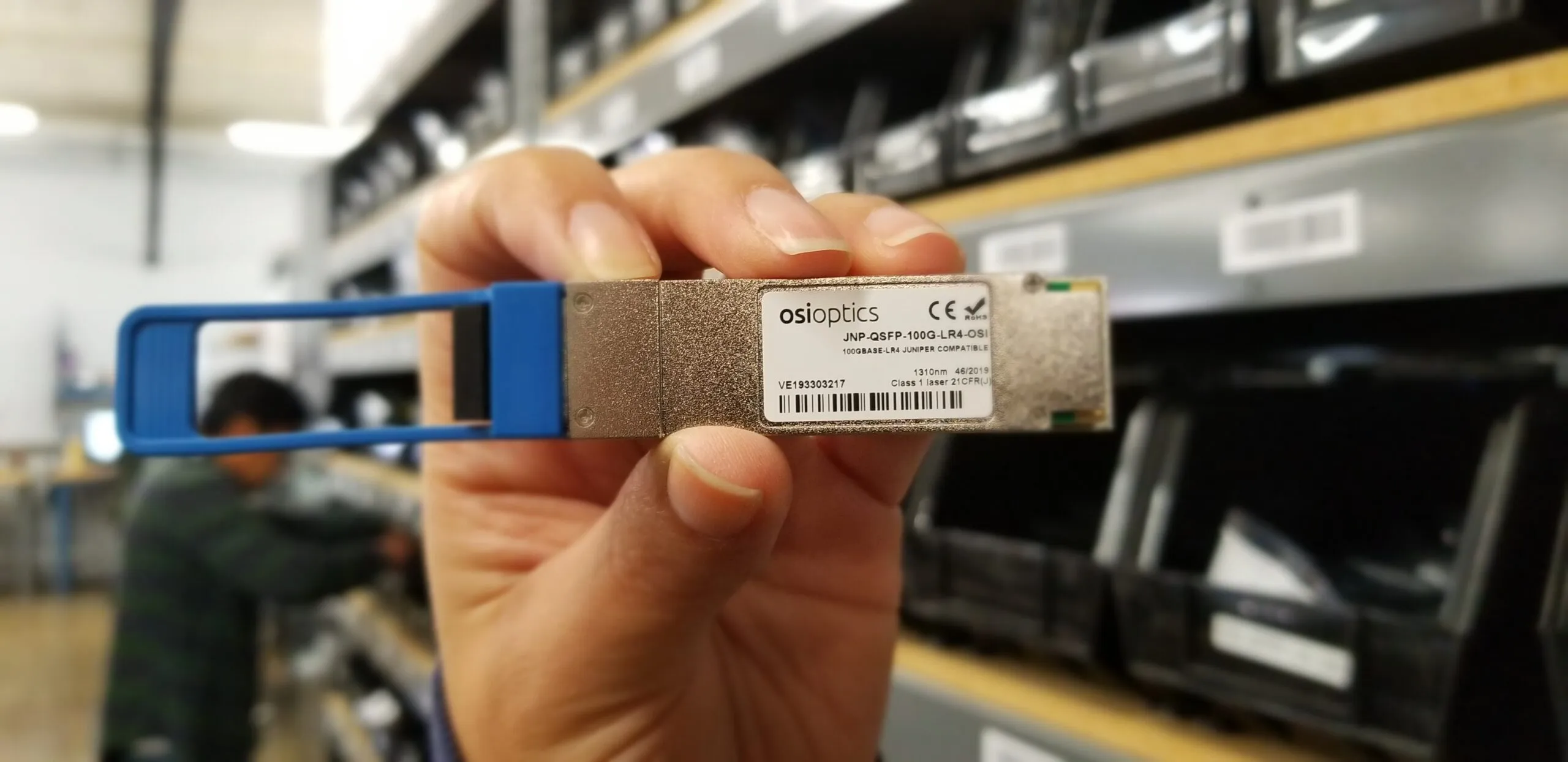
An optical transceiver is a compact networking device that converts electrical signals into optical signals, and back again. On one end, it connects to a switch, router, or server using an electrical interface. On the other, it connects to fiber optic cabling that carries data as pulses of light.
Simply put, the transceiver acts as the translator between networking hardware and the fiber infrastructure. Without it, high-speed fiber communication wouldn’t be possible.
Inside each transceiver are three core elements:
- A laser or light source that transmits data as light
- A photodetector that receives incoming light and converts it back into electrical signals
- Control electronics that manage signal integrity, speed, and compatibility
Although these devices are physically small, their performance directly impacts bandwidth, latency, power consumption, and network reliability.
How Optical Transceivers Work
When data leaves a server or switch, it starts as an electrical signal. The transceiver converts that signal into light using a laser tuned to a specific wavelength. That light travels through fiber optic cable -- sometimes across a room, sometimes across a campus, and sometimes across continents.
At the receiving end, another transceiver captures the light signal and converts it back into an electrical form that networking equipment can understand.
The efficiency of this process is one reason fiber optics dominate modern networking. Light travels faster and farther than electrical signals over copper, with far less signal loss and resistance. This is especially critical as global IP traffic continues to grow, driven largely by cloud services, video, and AI workloads.
Common Transceiver Form Factors
Optical transceivers come in standardized form factors designed to balance size, speed, and power efficiency. Some of the most common include:
SFP (Small Form-factor Pluggable) One of the earliest and most widely deployed formats, SFP modules typically support speeds up to 1Gbps. They’re still commonly found in legacy enterprise networks and access-layer infrastructure. Popular models include:
- GLC-TE (1G copper RJ-45)
- GLC-SX-MMD (1G SR multimode)
- GLC-LH-SMD (1G LX/LH single-mode)
SFP+ An evolution of SFP, SFP+ supports speeds up to 10Gbps while maintaining the same physical size. This made it a popular choice for enterprise data centers over the past decade. Examples include:
- SFP-10G-SR (10G SR multimode)
- SFP-10G-LR (10G LR single-mode)
- SFP-10G-ER (10G extended reach single-mode)
- DWDM-SFP10G-C (10G DWDM tunable extended reach)
QSFP (Quad Small Form-factor Pluggable)
QSFP modules combine multiple data channels in a single module, enabling higher bandwidth density. QSFP variants support speeds from 40Gbps up to 400Gbps and beyond, making them standard in modern data centers and cloud environments. Models include:
- QSFP-40G-SR4 (40G multimode)
- QSFP-100G-LR4-S (100G single-mode, 10km)
- QSFP-100G-ER4-S (100G 40km)
- QSFP-100G-ZR4-S (100G 80km)
QSFP-DD (Double Density)
Designed to meet the demands of hyperscale and AI-driven infrastructure, QSFP-DD doubles the number of electrical lanes, allowing significantly higher throughput without increasing port size. Popular models are:
- 400GBASE-SR8 QSFP-DD (400G multimode)
- 400GBASE-DR4 QSFP-DD (400G single-mode)
- 400G ZR / ZR+ QSFP-DD (coherent long-haul / DCI)
The choice of form factor directly affects how many ports a switch can support, how much power it consumes, and how easily the network can scale.
Where Optical Transceivers Are Used
Optical transceivers are used across nearly every type of modern network.
In data centers, they connect switches, storage systems, and servers across rows, halls, and campuses. As data center speeds climb from 10Gbps to 100Gbps and beyond, transceiver performance becomes a key bottleneck - or enabler - of growth.
In enterprise networks, transceivers link access switches to aggregation and core layers, support campus backbones, and enable long-distance connections between buildings.
In cloud infrastructure, transceivers are deployed at massive scale. Hyperscale operators purchase hundreds of thousands of modules at a time, optimizing aggressively for cost, power efficiency, and reliability. According to Dell’Oro Group, the optical transceiver market is projected to reach $19 billion by 2029, indicating how essential these components have become to digital infrastructure.
Telecom providers, research institutions, and industrial networks, among others, also rely heavily on optical transceivers to meet high bandwidth and long-distance connectivity requirements.
Key Terminology You'll Encounter with Optical Transceivers
Understanding a few core terms makes it much easier to evaluate optical transceivers and compare options.
Wavelength
Measured in nanometers (nm), wavelength refers to the color of light used to transmit data. Common wavelengths include 850nm for short-range multimode fiber and 1310nm or 1550nm for long-range single-mode fiber.
Fiber Type
- Multimode fiber (MMF) is used for short distances, typically inside data centers
- Single-mode fiber (SMF) supports much longer distances and higher performance, often spanning kilometers
Distance Rating: Optical transceivers are rated for specific distances, such as 100 meters, 2 kilometers, or 10 kilometers. Choosing a module with insufficient reach can lead to signal loss, while choosing a greater distance can unnecessarily increase cost.
Modulation: Modulation defines how data is encoded onto the light signal. More advanced modulation schemes allow higher data rates but often require better signal quality and more sophisticated hardware.
Data Rate: Measured in gigabits per second (Gbps), this indicates how much data the transceiver can handle. As AI workloads and real-time applications grow, higher data rates are becoming common.
Why Transceiver Choices Matter
Optical transceivers have a significant impact on network performance and cost. Power consumption alone can account for a meaningful portion of a data center’s operational expenses. In a typical 1RU switch, optical transceivers could represent 16% or more of its energy consumption under standard operating conditions.
Reliability is equally critical. A failed transceiver can bring down an entire link, disrupting applications and operations. This is why compatibility testing, quality control, lifecycle management, and vendor reputation are so important when sourcing optical components.
Vendor Compatibility and Lock-In Considerations
One of the most common questions organizations face when sourcing optical transceivers is whether they are locked into a specific networking vendor. While transceivers are built on widely accepted industry standards, compatibility policies can vary significantly between manufacturers.
Some networking vendors enforce compatibility requirements, but many environments successfully use third-party optical transceivers that meet industry standards. When properly tested and qualified, third-party optics can deliver equivalent performance while reducing costs and improving supply-chain flexibility.
For data centers and enterprises operating at scale, this flexibility can be critical. It allows teams to mitigate supply-chain disruptions, control operational costs, and extend the usable life of existing infrastructure… without compromising performance or reliability.
Looking Ahead
As networks evolve to support AI, edge computing, and ever-higher data volumes, optical transceivers will continue to advance. Faster speeds, lower power consumption, and greater interoperability are all driving innovation in this space.
For organizations building or upgrading their infrastructure, understanding optical transceivers is crucial in making informed decisions that balance performance, scalability, and cost over the long term.
At OSI Global, this practical understanding is what enables smarter sourcing, stronger networks, and infrastructure that’s built to last.